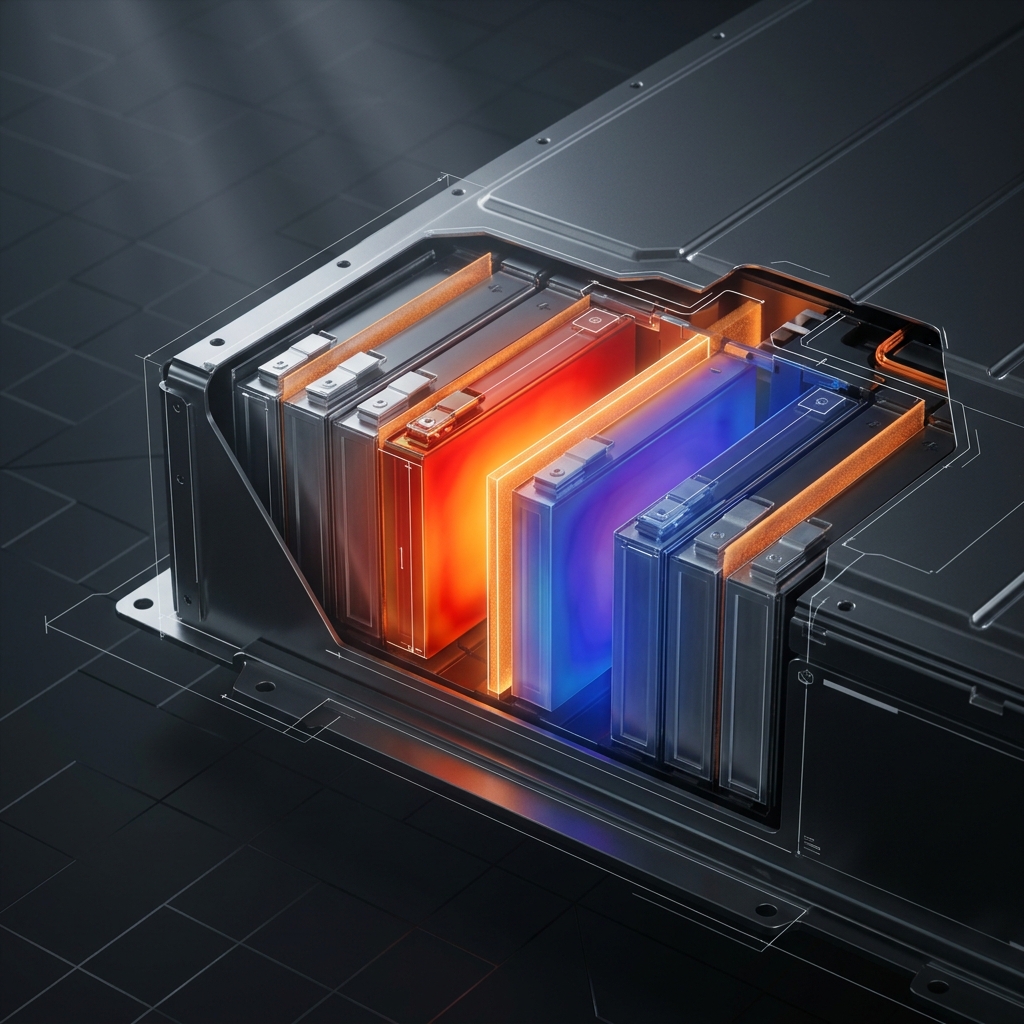
Aerogel-based thermal barrier materials engineered to help reduce thermal runaway propagation risk in EV battery systems — delivering high heat resistance in a compact form factor that supports tighter pack design and engineering flexibility.
When a single lithium-ion cell fails, it can generate extreme heat in milliseconds — triggering a chain reaction that spreads to neighboring cells, endangering the entire battery pack, the vehicle, and its occupants.
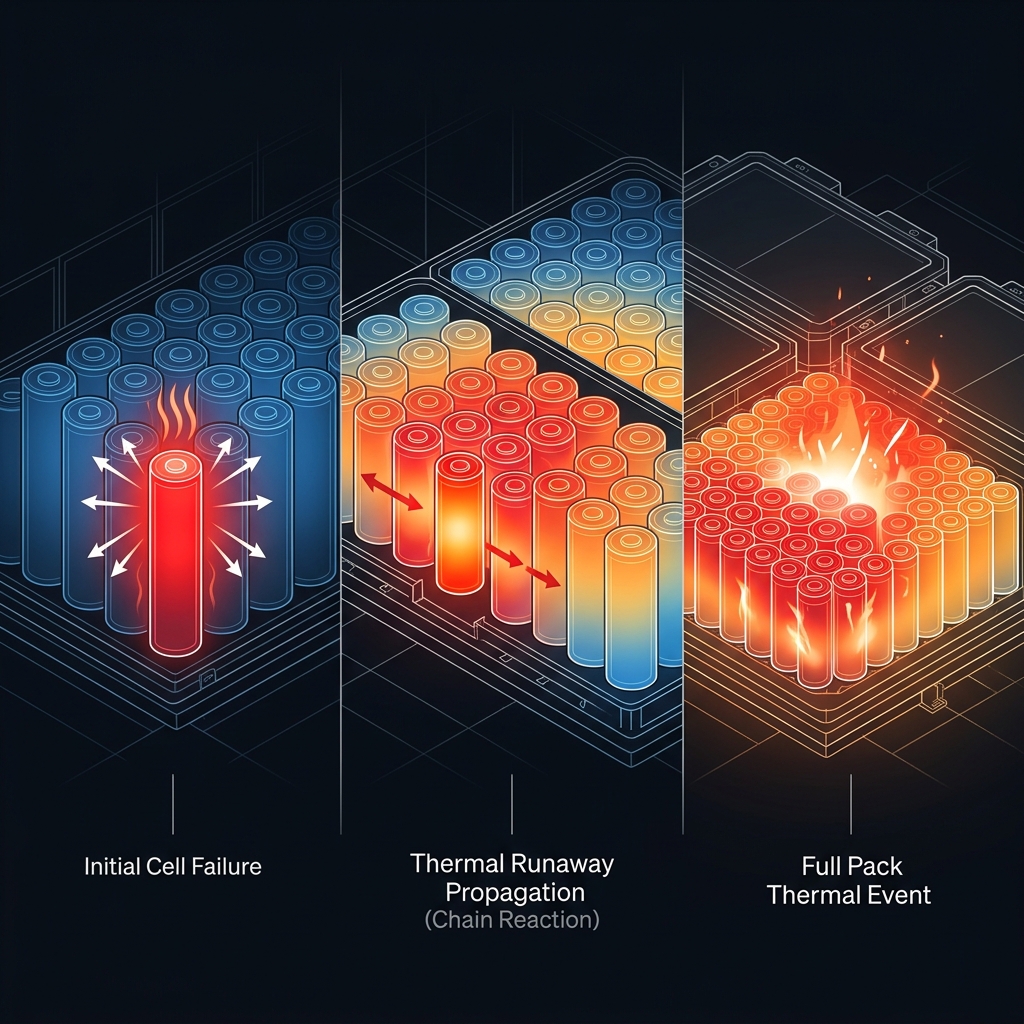
An internal short circuit, manufacturing defect, or external damage causes a single cell's temperature to rise rapidly — exceeding 400°C within seconds. Electrolyte begins to decompose, releasing flammable gases.
Without adequate thermal isolation, the extreme heat conducts through cell casings, bus bars, and direct material contact — raising adjacent cell temperatures past their critical thresholds.
Multiple cells enter simultaneous thermal runaway — creating an uncontrolled exothermic chain reaction with severe fire and explosion risk affecting the entire battery system.
A lithium-ion battery consists of anode and cathode units separated by thin, semi-permeable separators containing liquid electrolyte. During overcharging, charge/discharge cycling, or mechanical deformation, one or more cells can overheat beyond the critical threshold of approximately 170°C. When this occurs, the liquid electrolyte ignites — and critically, the burning electrolyte can generate its own oxygen, causing the fire to become self-sustaining. This results in rapid escalation to jet-flame combustion or explosion within seconds, making conventional extinguishing methods ineffective.
In automotive battery systems, passenger safety requires not only inter-cell insulation but also critical protection on the cabin-facing upper surfaces — shielding occupants from both extreme heat radiation and direct flame exposure. High-performance Levron Aerogel blanket products are engineered specifically to provide this life-safety-critical barrier.
Our silica aerogel-based insulation solutions meet international standards for fire safety and electrical leakage protection across all major energy storage battery chemistries — including emerging technologies that are not yet in widespread commercial use.
Green tags indicate emerging chemistries requiring integrated insulation for safe outer shell, inter-cell protection, and environmental containment — particularly Na-S systems operating at elevated temperatures.
Battery pack architecture is one of the most space-constrained engineering environments in automotive design. Every millimeter allocated to thermal protection is a millimeter taken from energy density, range, or cooling infrastructure.
Thick thermal barriers consume valuable packaging space — reducing energy density and limiting design freedom for cooling channels, structural elements, and bus bar routing.
In a 96-cell pack, every gram of barrier material per cell becomes 96 grams of added mass. Lightweight protection directly impacts vehicle range and efficiency.
The barrier must withstand extreme thermal events (400°C+ cell failure, 350°C+ gas venting) while maintaining structural integrity — thin doesn't mean weak.
Materials that absorb moisture lose insulation efficiency over time. In sealed battery environments, long-term hydrophobic stability is critical for reliable thermal protection.
Not a generic insulation product — a precision-engineered material system designed from the molecular level for compact, high-temperature thermal protection in battery-adjacent applications.
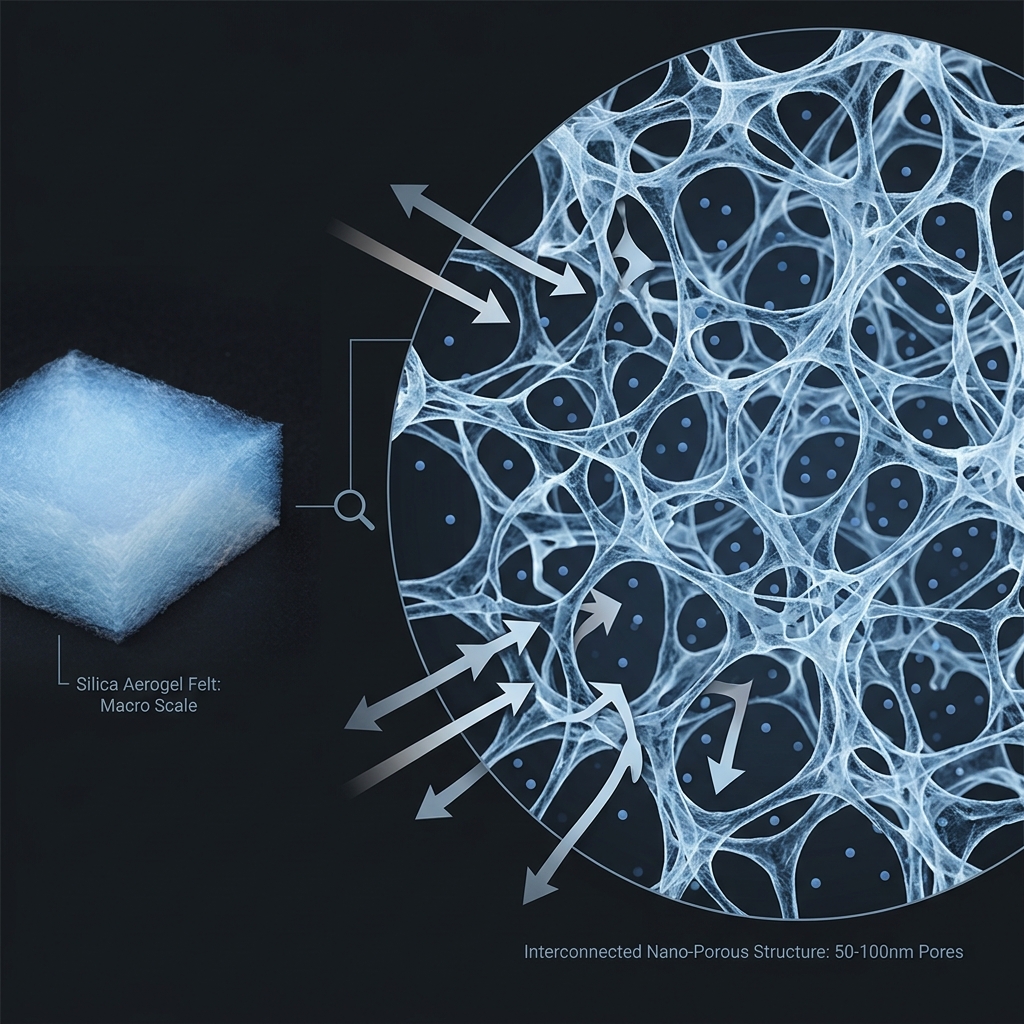
Nano-porous silica architecture with 50–100 nm pore sizes traps air at the molecular level — achieving thermal conductivity as low as 0.012 W/m·K at the platform level.
Standard glass wool-reinforced felt operates from -200°C to +650°C. Ceramic wool variants extend the upper limit to 1300°C for the most demanding thermal environments.
Achieves equivalent thermal resistance to 6cm rock wool in approximately 2cm — freeing critical packaging volume for energy density, cooling systems, and structural elements.
Water contact angle of 165° ensures complete moisture rejection. Unlike conventional insulators that lose 50%+ efficiency when wet, Levron maintains full thermal performance regardless of humidity.
Contains more than 90% air by volume — one of the lightest solid thermal barrier materials available. Minimizes mass impact in weight-critical EV battery applications.
Available as flexible felt sheets or precision granules. Custom thicknesses, multilayer composites, and application-specific configurations developed through engineering collaboration.
Levron Aerogel offers a comprehensive portfolio of aerogel composite configurations engineered specifically for battery thermal management — from standard inter-cell barriers to advanced multi-protection systems.
Silica aerogel composites with PET film coating (0.08 mm) on e-glass fiber or ceramic paper pad substrates. Available in 0.5, 1, 2, 3, and 4 mm thicknesses.
Special mica paper coated (0.1 mm) aerogel composites on e-glass fiber or ceramic paper pad substrates. Available in 0.5, 1, 2, 3, and 4 mm thicknesses.
Project-specific inorganic fire suppression aerogel composites with dielectric material layers — fully RoHS compliant for regulatory environments.
Alumina aerogel and silica-alumina hybrid aerogel combined with PCM (Phase Change Material) activated at 170°C — innovative composites designed for Li-ion batteries providing sustained temperature limit protection.
Advanced nano-encapsulated engineering products that precisely control surface emissivity — enabling optimized radiative heat management in high-performance battery architectures.
Every parameter represents measured performance from real Levron Aerogel testing — not theoretical projections or vendor estimates.
Platform-level conductivity among the lowest of any commercially available solid material. Felt product conductivity approximately 0.022–0.024 W/m·K in applied configuration.
Glass wool-reinforced configuration. Ceramic wool variant extends to 1300°C for extreme thermal environment applications.
Superhydrophobic behavior maintained even after mechanical impact. Active hydrophobicity reported up to 650°C operating temperature.
Ultra-high porosity creates one of the lightest solid materials known — enabling thermal protection without meaningful weight penalty.
Non-combustible classification. In controlled 1000°C flame testing, 2cm Levron Felt outlasted 9cm of combined conventional materials.
Sufficient structural integrity for cell-to-cell compression environments within battery modules and pack assemblies.
High specific heat capacity contributes to thermal energy absorption during rapid temperature excursion events.
Maintains thermal performance, hydrophobicity, and structural integrity over extended periods. No bacteria or mold growth. Zero maintenance required.
A technically informed evaluation of key performance parameters across insulation material classes relevant to EV battery thermal protection.
| Parameter | Rock Wool | Glass Wool | Standard Aerogel | Levron Aerogel |
|---|---|---|---|---|
| Thermal Conductivity | 0.035–0.045 W/m·K | 0.032–0.044 W/m·K | 0.018–0.025 W/m·K | 0.012–0.016 W/m·K |
| Max Operating Temp | 500–700°C | 400–500°C | 600–900°C | Up to 1300°C |
| Moisture Resistance | Poor — absorbs water | Poor — absorbs water | Moderate | 165° superhydrophobic |
| Thickness for Equal R | 6 cm | 5–6 cm | 2–3 cm | ~2 cm |
| Fire Test (1000°C) | 5cm fails at 9 min | 4cm fails at 9 min | Variable | 2cm — test stopped |
| Weight Impact | High (dense) | Moderate | Low | Ultra-low (>90% air) |
| Expected Lifetime | 10–15 years | 10–15 years | 15–20 years | 20+ years |
Data represents Levron Aerogel internal testing and published material properties. Comparison values are representative ranges for conventional material classes. Actual performance depends on specific product configurations, test conditions, and integration design.
Levron Aerogel's thermal performance is not achieved through material thickness — it's engineered into the nano-scale structure of the material itself.
A three-dimensional network of interconnected silica particles creates nano-scale pores smaller than the mean free path of air molecules — physically constraining gas-phase thermal conduction.
Nano-porous architecture simultaneously limits conduction (solid path minimized), convection (air molecules constrained), and radiation (scattered within the pore network) — addressing all three heat transfer pathways.
The material is overwhelmingly composed of trapped air — resulting in exceptionally low density and one of the lightest solid thermal barriers commercially available.
Chemical modification of the silica surface creates superhydrophobic behavior (165° contact angle) — ensuring thermal performance is never degraded by moisture absorption, even in humid operational environments.
Levron Aerogel thermal barriers can be engineered into multiple zones within battery pack architecture — each addressing a specific thermal propagation pathway.
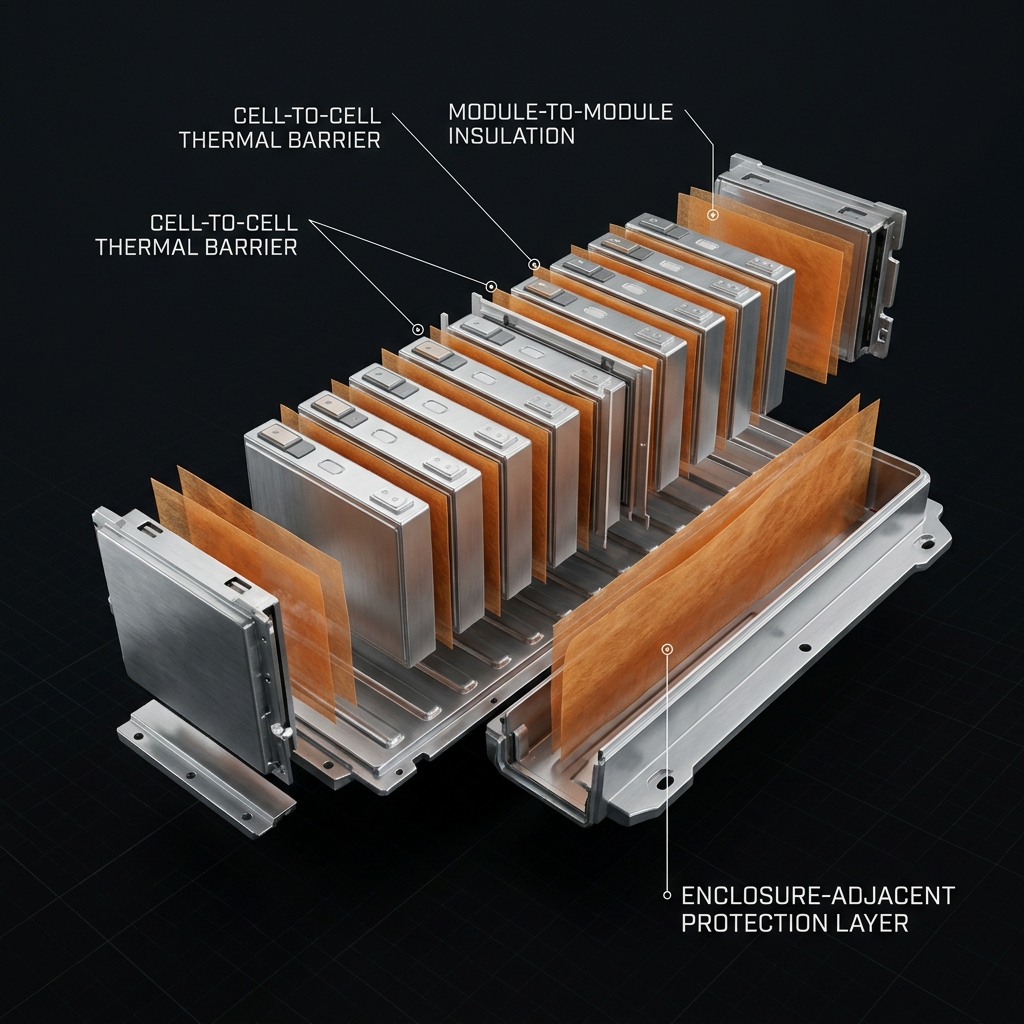
Thin Levron Aerogel Felt sheets placed between individual cells to interrupt direct thermal conduction during a cell failure event. The compact form factor minimizes impact on cell-to-cell spacing.
Thicker barrier configurations between battery modules to contain thermal events at the module level and prevent propagation to adjacent modules within the pack structure.
Thermal isolation layers between battery pack compartments and vehicle structural elements — protecting the vehicle cabin and critical systems from pack-level thermal events.
Thermal protection lining inside battery enclosure walls — serving as a last line of passive defense between the battery system and the external vehicle environment.
In automotive battery systems, the cabin-facing upper surfaces of the battery pack require protection from both extreme heat radiation and direct flame exposure during thermal runaway events. This zone is critical for occupant safety — Levron Aerogel blanket products are specifically designed to provide high-performance insulation that safeguards passengers by preventing heat and fire propagation into the vehicle cabin.
Levron Aerogel thermal barrier solutions serve all battery-powered systems requiring fire safety and electrical leakage protection to international standards.
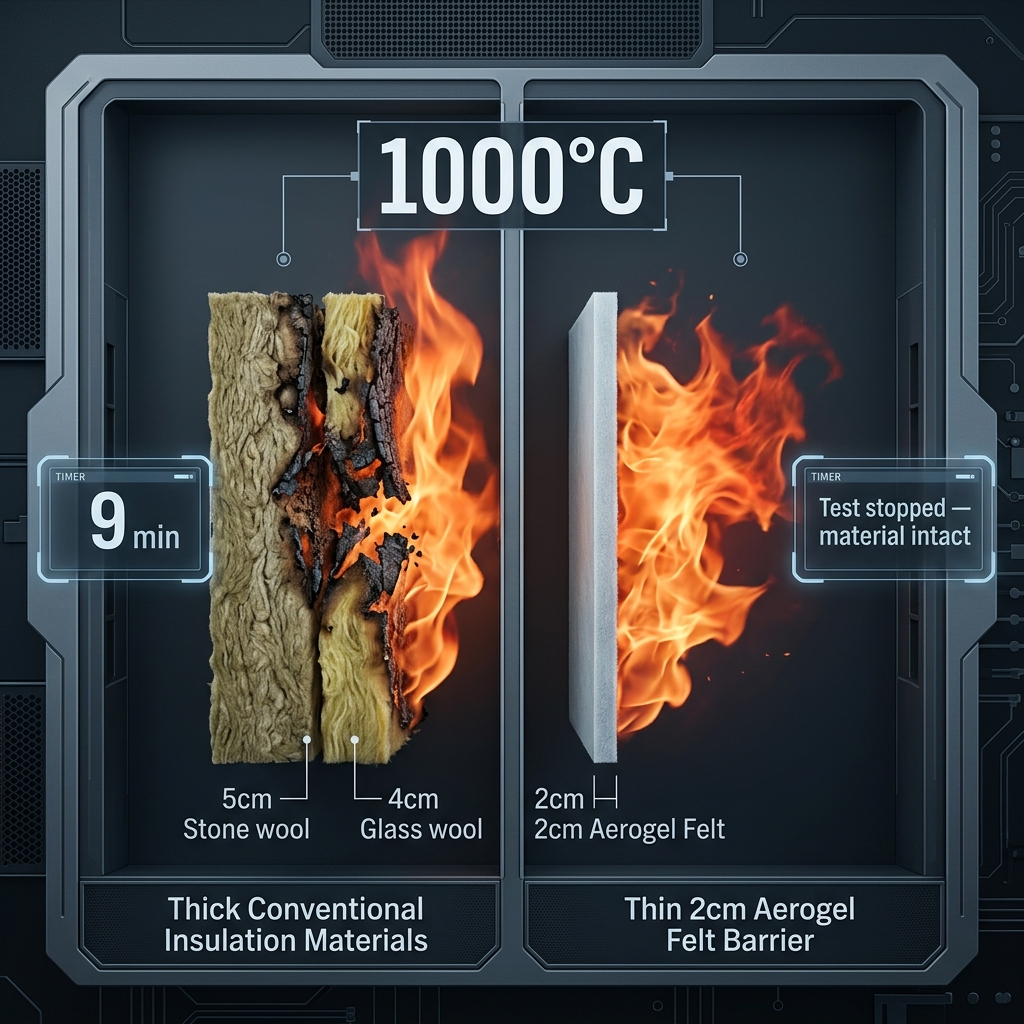
In a controlled laboratory flame test at 1000°C: 5cm rock wool combined with 4cm glass wool failed within 9 minutes. 2cm Levron Aerogel Felt withstood continuous flame exposure — the test was stopped voluntarily with the material still intact.
Conventional insulation materials (rock wool, glass wool) lose 50%+ thermal efficiency when exposed to moisture. Levron Aerogel's 165° superhydrophobic surface completely rejects water — maintaining full insulation performance in any humidity condition.
No performance degradation over extended service periods. No bacteria growth. No mold formation. No maintenance required. The material maintains its thermal, hydrophobic, and structural properties for 20+ years.
7 years of dedicated R&D, 4,000 m² of integrated production capacity, and multi-aerogel chemistry expertise make Levron Aerogel a serious long-term partner for advanced thermal protection development.
From thousands of laboratory experiments to industrial-scale production. Deep aerogel chemistry knowledge spanning silica, polymer, metal oxide, carbon, and cellulose aerogel systems.
Complete production infrastructure — from raw material processing through Sol-Gel synthesis to final product formation. Not an outsourced supply chain — an integrated manufacturing platform.
Aerogel felt (flexible thermal barriers) and aerogel granules (particle-based solutions) — with custom configurations, thicknesses, and multilayer composites available through engineering consultation.
Application-specific solutions designed in collaboration with OEM engineers, system integrators, and end users. From initial samples through pilot evaluation to scaled supply.
A structured evaluation pathway designed for engineering teams and procurement professionals who need confidence before commitment.
Share your application requirements, thermal challenges, and design constraints. Our materials engineering team evaluates fit and recommends initial configurations.
Receive material samples in relevant formats and thicknesses. Conduct your own thermal, mechanical, and environmental testing using your internal protocols.
Collaborate on application-specific configurations — custom thicknesses, multilayer composites, die-cut formats, adhesive integration, and packaging specifications.
Small-batch manufacturing run to validate production consistency, quality parameters, and supply chain logistics before scaling to volume.
Volume production from our integrated 4,000 m² facility — with quality control, lead time commitments, and ongoing engineering support.
Access technical documentation, material data, and educational resources to support your evaluation process.
Full specifications: thermal conductivity, temperature range, dimensions, fire classification, and mechanical properties.
Download PDF →Particle size, thermal conductivity, surface area, transparency, and application guidance for granule-based solutions.
Download PDF →Environmental and safety specifications. Levron Aerogel is non-toxic, eco-safe, and human-friendly.
Download MSDS →Receive physical samples of Levron Aerogel Felt and Granules for hands-on evaluation and internal testing.
Request Samples →Detailed benchmarking of aerogel versus conventional thermal protection materials across key performance parameters.
Request Guide →Book a one-on-one session with our materials engineering team to discuss your specific application requirements.
Schedule Call →The Levron Aerogel platform achieves thermal conductivity of 0.012–0.016 W/m·K at the base material level. In applied felt configuration with glass wool reinforcement, conductivity is approximately 0.022–0.024 W/m·K — still significantly lower than any conventional insulation alternative.
Standard glass wool-reinforced felt operates from -200°C to +650°C continuously. For extreme-temperature applications, a ceramic wool-reinforced variant extends the upper operating limit to approximately 1300°C.
Conventional insulation materials (rock wool, glass wool) absorb moisture over time, losing 50%+ of their thermal efficiency. Levron Aerogel's 165° contact angle means complete water rejection — ensuring consistent thermal protection throughout the battery pack's lifetime, even in humid environments.
Levron Aerogel Felt can be produced in a range of thicknesses to suit specific integration requirements. For cell-to-cell applications, thin formats (1–3mm) are typically discussed. Custom thicknesses and multilayer configurations are developed through engineering collaboration.
Yes. Levron Aerogel Felt is flexible and can be processed into custom shapes, die-cut formats, and specific dimensions. Adhesive-backed configurations and multilayer composite structures are available through our engineering development process.
Standard material samples can typically be prepared and shipped within a short timeframe. Custom-format samples require engineering consultation to define specifications before production. Contact our team for specific lead times.
Choose the pathway that matches your evaluation stage. Our team is ready to support engineers, procurement professionals, OEM integrators, and strategic partners.
Discuss your thermal management challenge with our materials engineering team. Get technical answers fast.
Talk to an EngineerRequest pricing, lead times, and volume capabilities for your specific application requirements.
Request QuoteStart with a focused evaluation — from material sampling to co-development of custom solutions.
Start a PilotLearn about our technology platform, market position, and growth trajectory.
Partnership Inquiry