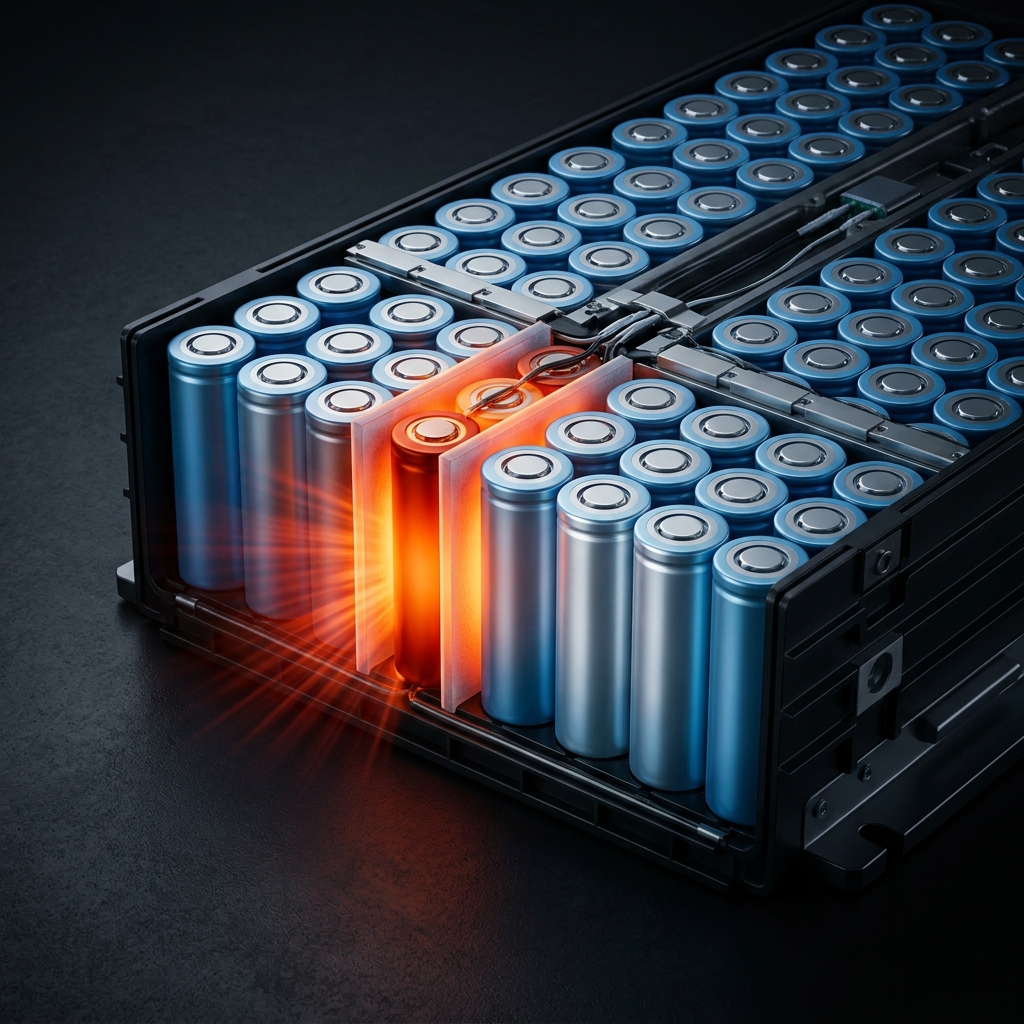
Levron Aerogel develops engineered nano-porous thermal solutions for battery cell, module, and pack manufacturers seeking compact, high-temperature, passive thermal protection.
Battery manufacturers operate under extreme constraints of packaging density, heat management, and cost. Conventional materials simply take up too much volume or fail under thermal runaway conditions.
To optimize energy density while maintaining safety compliance, engineering teams must evaluate next-generation passive materials that fit seamlessly into modern workflows—without adding bulk to the architecture. Our platform bridges the gap between material science and battery scale-up.
Energy density demands leave zero room for bulky 10mm conventional insulation.
Single-cell failures must be compartmentalized passively to prevent pack-level disasters.
Materials must be die-cut, automated, and seamlessly integrated into high-speed lines.
Localized thermal events (700°C–1000°C) require immediate containment. Without robust passive barriers, one cell failure can destroy a megawatt-hour BESS or an entire EV package.
Upon internal short circuit, structural barrier layers slow outward heat flux drastically, giving active safety systems critical response time.
By using low-conductivity (0.012 W/m·K) materials between modules, a thermal event is structurally isolated from neighboring capacity blocks.
Our lab testing provides measurable properties (compressive strength, A1 fire rating) ensuring material behaves predictably across UN38.3/UL9540A test scenarios.
In modern EV and ESS battery architectures, mm-level savings translate to massive performance gains.
We engineer thermal barrier solutions for every structural level, from individual cell wrapping to pack-level acoustic and fire mitigation.
Ultra-thin patterned thermal sheets placed directly between prismatic or pouch cells. Functions simultaneously as a thermal blocker and a compressible expansion pad.
Request Engineering DataThicker composite barriers (e.g., 3-5mm felt) installed as fireproof bulkheads separating parallel battery modules, drastically reducing module-to-module propagation risk.
Request Engineering DataLarge-format aerogel felts lining the battery housing cover. Prevents outward fire penetration towards the passenger cabin or BESS facility structures.
Request Engineering DataCompare our nano-porous silica platform conceptually against conventional thick insulators and moisture-sensitive foams.
| Property Requirement | Polymer Foams | Mica / Wool Pads | Levron Aerogel Platform |
|---|---|---|---|
| High Temp Resistance (>800°C) | Melts/Combusts | Performs well | Yes (up to 1300°C available) |
| Thickness Efficiency | Requires Bulk | Requires Bulk | Extreme (2mm–5mm) |
| Moisture Stability | Good | Poor (Absorbs / Degrades) | Superhydrophobic |
| Thermal Conductivity | ~0.035 W/mK | ~0.040 W/mK | ~0.012 - 0.016 W/mK |
| Weight Impact | Light | Heavy | Ultra-Light (>90% Air) |
Traps air molecules mechanically preventing convective flow.
Renders the internal surface permanently hydrophobic.
Silica base structure provides innate non-combustibility.
Hit energy-density targets without compromising safety clearance.
No moisture degradation equals consistent performance over 20+ years.
Predictable flame arrestment ensures higher pass rates on destructive pack tests.
Detailed architecture discussion and thermal requirement scoping under NDA.
Selection of format (sheet vs felt), composite reinforcement, and thickness.
Evaluation of custom cut samples in customer lab environment.
Iterative pilot roll-out from our 4,000 m² integrated production line.
CTP (Cell-to-Pack) architectures requiring extreme bottom-shield and cell-barrier protection.
Grid-scale high voltage pack fire isolation protecting infrastructure and adjacent racks.
Ultra-lightweight constraints where minimizing mass while surviving thermal runaway is mission-critical.
Proprietary sol-gel chemistry proven beyond the lab bench.
Scaling capacity tailored for high-volume automotive and industrial contracts.
We supply advanced chemistry via customized formats, not strict commoditized part numbers.

Our engineering team is ready to discuss thermal protection, material specs, and pilot sample integration.