Aerogel is an ultra-light, nano-porous advanced material — more than 90% air by volume — with one of the lowest thermal conductivities of any known solid. Levron Aerogel applies this remarkable material platform to battery safety, thermal protection, industrial insulation, and advanced engineering systems.
Aerogel is not a foam. Not a fiber. Not a conventional bulk insulation material. It is an advanced engineered solid with a three-dimensional nano-scale network — a material so porous that more than 90% of its volume is trapped air. Despite being one of the lightest solid structures known, it delivers some of the strongest thermal insulation performance available.
Aerogel belongs to a class of ultra-light, high-performance materials created through precise sol-gel chemistry. Levron Aerogel's platform centers on silica aerogel — engineered at the molecular scale for thermal protection.
The internal structure is overwhelmingly composed of trapped air — confined within billions of nano-scale pores. This creates one of the lightest solid materials ever produced, with densities as low as 3 mg/cm³.
Pure silica aerogel achieves thermal conductivity as low as 0.012–0.016 W/m·K. Levron Aerogel Felt delivers ~0.022–0.024 W/m·K in applied product form — among the lowest of any commercially available insulation material.
Pore sizes of 50–100 nm — smaller than the mean free path of air molecules. This physically constrains gas-phase heat transfer, creating an insulation mechanism that is fundamentally different from conventional materials.
Aerogel is distinct from all conventional insulation categories. Its nano-scale pore network creates properties that foams, fibers, and bulk materials cannot achieve — thinner, lighter, and more thermally efficient.
Beyond thermal insulation: aerogel can be engineered for fire resistance, hydrophobicity, acoustic control, filtration, and chemical absorption — multiple functions within a single material layer.
Aerogel's thermal performance comes from its nano-porous architecture. Billions of tiny pores trap air at the molecular level, simultaneously suppressing all three mechanisms of heat transfer: conduction, convection, and radiation.
Unlike conventional materials that address one or two heat transfer mechanisms, aerogel's nano-porous structure simultaneously suppresses all three.
Conventional insulation works by trapping air in large pockets, requiring thick layers for adequate performance. Aerogel traps air at the molecular level — achieving superior thermal resistance in a fraction of the thickness.
Where rock wool needs 6 cm, aerogel achieves the same thermal resistance in ~2 cm. This compactness is not incremental — it is transformative for space-constrained engineering systems.
Aerogel's >90% air structure means it adds minimal mass to any system. In weight-sensitive applications — EVs, aerospace, portable equipment — this translates directly to better performance and efficiency.
Conventional insulation absorbs moisture and loses 50%+ of thermal efficiency. Aerogel's 165° superhydrophobic surface rejects water completely — maintaining full performance in all conditions.
Standard glass wool fails at 400–500°C. Levron Aerogel operates to 650°C (standard) and 1300°C (ceramic variant) — covering temperature ranges that conventional materials simply cannot address.
Beyond insulation: fire resistance, acoustic control, filtration, hydrophobicity, and chemical stability — multiple engineering functions integrated into a single material layer.
Each property is a direct consequence of aerogel's nano-porous architecture. Together, they create a multifunctional material platform unlike anything in conventional insulation.
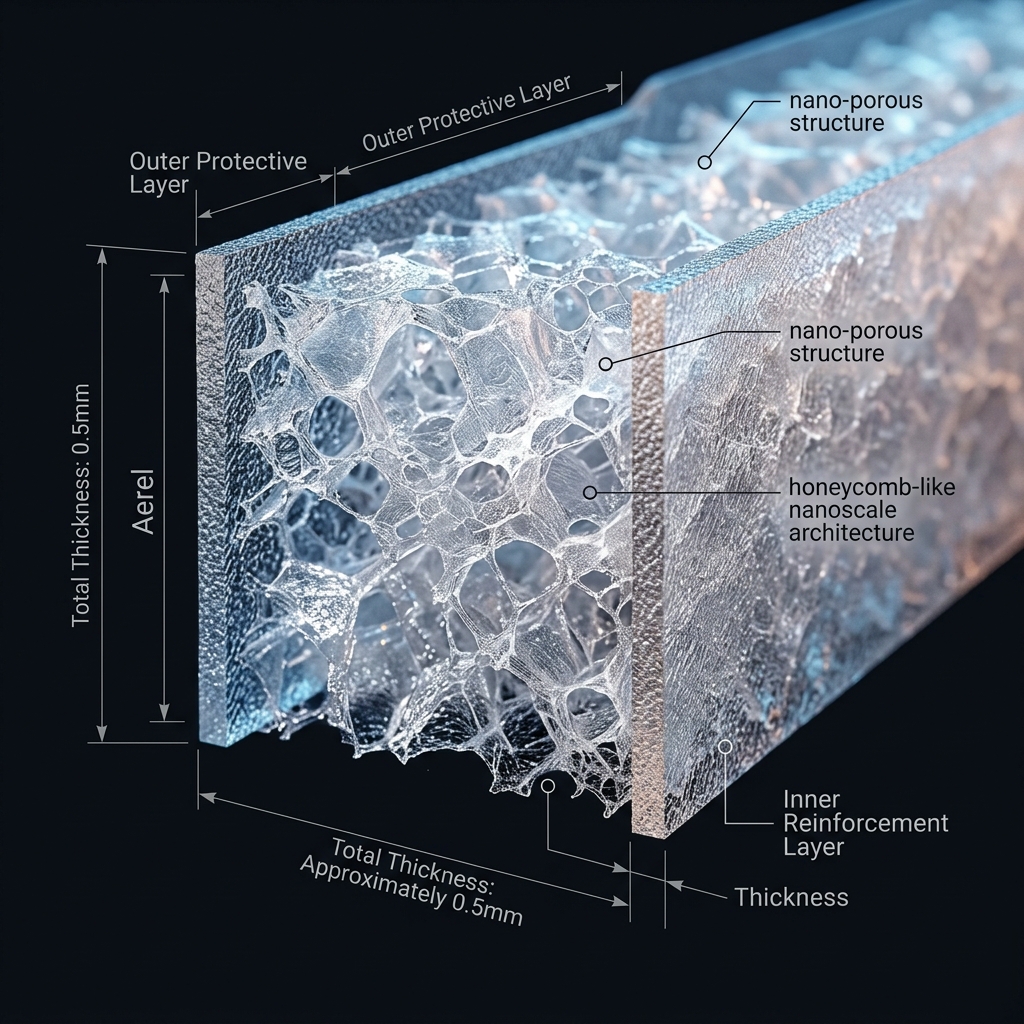
The exceptional performance of aerogel is not achieved by adding more material. It is engineered into the fundamental molecular structure — a three-dimensional silica network that transforms the physics of heat transfer.
Levron Aerogel's core platform is built on silica (SiO₂) — one of the most abundant, stable, and well-understood material chemistries. The sol-gel synthesis process creates a continuous three-dimensional silica network with precisely controlled pore architecture.
The silica network forms an incredibly fine scaffold — accounting for only 5–10% of volume — that holds its shape while the remaining 90–95% is trapped air. This architecture creates a material that behaves as a solid but has the density characteristics of a gas.
Surface modification creates superhydrophobic behavior (165° contact angle) that persists to 650°C. This is not a coating — it is chemically bonded to the silica network, ensuring hydrophobicity remains stable under mechanical stress and thermal exposure.
Pore size controls convection suppression. Solid-phase fraction controls conduction pathways. Surface area controls radiation scattering. Every performance characteristic traces back to the nano-porous architecture — making aerogel a material where structure is function.
Modern systems need lighter, thinner, smarter thermal protection materials. Aerogel's unique combination of properties makes it relevant across the most demanding application environments — from electric vehicle battery packs to industrial furnace walls.
Levron Aerogel is not only explaining aerogel — we are applying it. Our product platform translates nano-porous material science into commercially ready, engineered product formats for real-world thermal protection challenges.
Cell-to-cell barriers, module-level fire barriers, and integrated thermal management for electric vehicle battery packs.
Thermal protection for large-format energy storage systems — containerized, rack-mounted, and modular configurations.
Mission-critical thermal protection for defense programs, special engineering projects, and confidential co-development partnerships.
A structured evaluation across key performance parameters. This comparison illustrates why aerogel represents a different class of thermal protection — not just an incremental improvement.
| Property | Rock Wool | Glass Wool | Standard Aerogel | Levron Aerogel |
|---|---|---|---|---|
| Thermal Conductivity | 0.035–0.045 W/m·K | 0.032–0.044 W/m·K | 0.018–0.025 W/m·K | 0.012–0.016 W/m·K |
| Max Temperature | 500–700°C | 400–500°C | 600–900°C | Up to 1300°C |
| Water Resistance | Poor — absorbs moisture | Poor — loses efficiency | Moderate | 165° superhydrophobic |
| Fire Test (1000°C) | 5cm fails at 9 min | 4cm fails at 9 min | Variable | 2cm — test stopped |
| Thickness for Equal R | 6 cm | 5–6 cm | 2–3 cm | ~2 cm |
| Weight / Density | High (40–200 kg/m³) | Moderate (10–96 kg/m³) | Low | Ultra-light (>90% air) |
| Multifunctionality | Insulation only | Insulation only | Insulation + some | Thermal + Fire + Hydro + Acoustic |
| Expected Lifetime | 10–15 years | 10–15 years | 15–20 years | 20+ years |
Values represent Levron Aerogel internal testing data compared to representative ranges for conventional material classes. Actual performance depends on specific configurations and operating conditions.
A material's laboratory performance means nothing if it cannot maintain that performance in real-world conditions. Aerogel's resilience against fire, moisture, and environmental degradation is what makes it more than a laboratory curiosity.
Most conventional insulation materials absorb moisture over time — especially in outdoor, underground, or humid industrial environments. When insulation absorbs water, its thermal conductivity increases dramatically, often losing half or more of its insulating effect. Aerogel's superhydrophobic surface eliminates this failure mode entirely.
Thermal protection materials must not become part of the problem during a fire event. Aerogel's A1 non-combustible classification means it does not contribute to fire load, cannot sustain flame, and maintains structural integrity under extreme thermal exposure — the shielding itself never becomes a vulnerability.
7 years of dedicated R&D. 4,000 m² integrated production. An existing product platform. Levron Aerogel is a real advanced materials company — established, scalable, and partnership-ready.
Thousands of laboratory experiments spanning silica, polymer, metal oxide, carbon, and cellulose aerogel systems. Deep chemistry knowledge enabling rapid material customization for specialized requirements.
Complete vertical integration — from raw material processing through Sol-Gel synthesis to final product formation. Full quality control at every production stage. Not dependent on external supply chains.
Commercial products already in market — aerogel felt, granules, and thermal barrier sheets. This is not a technology in development; it is a technology in production and application.
Beyond silica: R&D capabilities across polymer aerogel, metal oxide aerogel, carbon aerogel, and cellulose aerogel — enabling next-generation materials for emerging engineering challenges.
Access technical documentation, educational explainers, and downloadable resources to support your aerogel material evaluation and understanding.
Full specifications: thermal conductivity, temperature range, fire classification, dimensional options, and environmental performance data.
Download PDF →Particle size, thermal conductivity, surface area, hydrophobicity, and application guidance for granule-based configurations.
Download PDF →Environmental and safety specifications. Non-toxic, eco-safe material compliant with workplace safety requirements.
Download MSDS →Understanding what makes aerogel's 0.012 W/m·K thermal conductivity exceptional — and what it means for your application requirements.
Request Guide →Why 165° contact angle superhydrophobicity matters for insulation reliability — and how it maintains thermal performance in wet environments.
Request Guide →Receive physical samples of Levron Aerogel Felt and Granules for hands-on evaluation and internal testing protocols.
Request Samples →The core aerogel platform is built on silica (silicon dioxide, SiO₂) — one of the most abundant materials on Earth. Through a sol-gel synthesis process, silica precursors are transformed into a three-dimensional nano-porous network. The liquid within the gel is then replaced with air through careful drying (often supercritical drying), leaving behind the solid silica skeleton surrounding billions of nano-scale air pockets.
While aerogel has very low density, the interconnected silica network provides sufficient structural integrity for insulation and thermal barrier applications. In product formats like Levron Aerogel Felt, the silica aerogel is reinforced with glass wool or ceramic wool fibers — creating a material that is flexible, mechanically stable, and suitable for engineering applications with compressive strength around 40 kPa.
The platform-level thermal conductivity of pure silica aerogel is 0.012–0.016 W/m·K. When aerogel is formed into applied products like felt (with reinforcement fibers), the thermal conductivity is slightly higher — approximately 0.022–0.024 W/m·K — due to the presence of the reinforcement material. Both values are dramatically lower than conventional insulation materials.
Levron Aerogel products are non-toxic, eco-safe, and human-friendly. They do not produce hazardous dust or fibers under normal handling conditions. Material Safety Data Sheets (MSDS) are available for all products, confirming compliance with workplace safety standards.
Polyurethane foam typically has thermal conductivity of 0.022–0.028 W/m·K — similar to aerogel felt in thermal performance. However, foam lacks aerogel's hydrophobicity (foams absorb moisture), high-temperature capability (foams degrade at relatively low temperatures), fire resistance (foams are combustible), and multifunctional properties. Aerogel provides a fundamentally different performance profile.
Yes. Levron Aerogel offers custom configurations including specific thicknesses, reinforcement types (glass or ceramic wool), die-cut geometries, composite laminates, and specialized surface treatments. Our engineering team supports co-development partnerships for application-specific material solutions.
Aerogel has a higher per-unit cost than conventional insulation materials. However, total installed cost analysis often favors aerogel when considering: dramatically reduced material volume (3× thinner), reduced installation labor, lower structural requirements (lighter), longer lifespan (20+ years vs 10–15), zero-maintenance, and elimination of moisture-related performance degradation.
| Term | Definition |
|---|---|
| Aerogel | An ultra-light, nano-porous solid material derived from gel in which the liquid component has been replaced with air, maintaining the solid structure. |
| Sol-Gel Process | A chemical synthesis method used to create solid materials from small molecules. In aerogel production, it transforms precursor solutions into a gel network. |
| Nano-Porous | Having pores on the nanometer scale (1–100 nm). Aerogel pores are typically 50–100 nm in diameter. |
| Thermal Conductivity | A measure of a material's ability to conduct heat. Lower values = better insulation. Measured in watts per meter-kelvin (W/m·K). |
| Superhydrophobic | Having extremely high water repellency, defined by water contact angles exceeding 150°. Levron Aerogel achieves 165°. |
| Porosity | The percentage of a material's total volume that is void (air-filled). Aerogel porosity: 90–95%. |
| Mean Free Path | The average distance a molecule travels before colliding with another. When pore size < mean free path, gas-phase heat transfer is suppressed. |
| Thermal Runaway | An uncontrolled chain reaction in battery cells where rising temperature triggers further heat generation, potentially leading to fire or explosion. |
Whether you're evaluating materials for a specific application, exploring aerogel for the first time, or ready to discuss a project — choose the pathway that matches your interest.
Explore Levron Aerogel Felt, Granules, and Thermal Barrier Sheets — our commercially ready product platform.
Explore ProductsLearn how aerogel thermal barriers protect battery packs from thermal runaway propagation.
Explore EV SafetyPrecision-engineered thermal barriers for battery packs and module-level fire protection.
View SheetsDiscuss your application requirements with our materials engineering team.
Talk to EngineerReceive physical samples for hands-on evaluation and internal testing protocols.
Request Sample