Levron Aerogel develops specialized, custom-engineered thermal solutions for demanding EV, BESS, and industrial applications. We combine advanced material science with rigorous format adaptation—engineering protection specifically for your system's exact constraints.
Real-world systems have geometry, space, temperature, and environmental constraints that generic off-the-shelf products do not fully solve. We reduce the compromise between thermal performance, spatial efficiency, and safety through rigorous custom engineering.
Advanced engineering platforms—from dense EV battery packs to compact process heat manifolds—frequently encounter a breaking point when integrating standard insulation.
If the barrier is too thick, energy density is compromised. If it’s too rigid, manufacturing and automated assembly become impossible. When system performance depends on precise structural integration, adapting the product form-factor is just as critical as the base chemistry.
Achieving protective R-values in millimeter tolerances.
Adaptability to non-flat or multi-axial surfaces.
Accounting for localized hot-spots and transient runs.
Sustained hydrophobicity under vibration/moisture.
We don't profess unlimited capabilities. Rather, we build custom solutions through a structured set of configurable parameters that maintain our foundational material standards.
Customization from ultra-thin sub-millimeter configurations for battery cells to multi-layer deep thermal barriers for bulk storage.
Combining aerogel felt or sheets with structural foils, flame-retardant laminations, or reflective layers to meet compound specs.
Tuning the material matrix for extreme hydrophobic longevity or shifting binder compounds for upper-limit temperature resilience (up to 1300°C).
Die-cut geometries, compressible edge boundaries, and handling-optimized face finishes for automated robotic assembly lines.
Custom engineering isn't a consulting engagement—it’s a disciplined industrial pathway toward validated supply.
Initial technical deep dive. We review system constraints, geometry, safety targets, and expected thermal load to select a base material profile.
We propose a custom form-factor—including specific thickness, layering architecture, and cut dimensions—supplying preliminary thermal data models.
Delivery of physical prototypes and concept-stage samples to your engineering team for internal bench testing and mechanical fitment trials.
Finalizing the blueprint and transitioning from one-off lab-scale validation into structured, repeatable, scalable industrial supply.
Custom solutions are scientifically anchored to our validated foundational materials. We adapt and hybridize existing proven properties rather than starting from raw chemistry.
Our flexible 6-10mm silica matrix with glass-wool reinforcement. Highly adaptable for pipeline, large tank wrapping, and industrial enclosures.
View Standard DetailsUltra-thin, structural, non-combustible barriers specifically formulated for high-density spacing (e.g., cell-to-cell EV barriers).
View Standard DetailsBulk aerogel particulates functioning as a superior powder fill, moldable substrate, or active ingredient in custom structural housings.
View Standard DetailsCombining base platforms—such as die-cutting Thermal Sheets and layering them with reflective foils or structural adhesives—to deliver a hybrid component that fulfills an exact multi-dimensional spec constraint.
Different industries require substantially different customization logic.
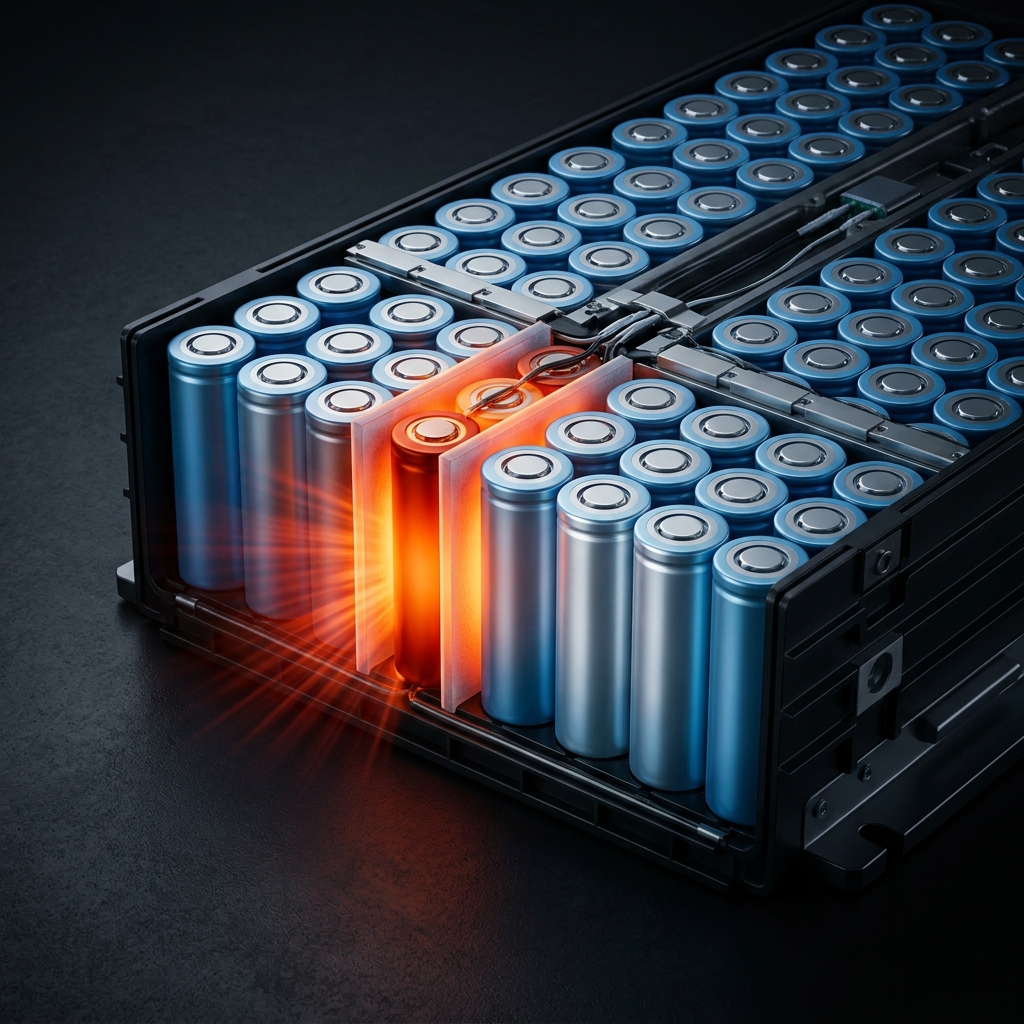
For automotive OEMs, volume is hyper-constrained and fire safety is paramount. We engineer ultra-thin barriers designed to fit between cylindrical or pouch cells, adapting the material matrix to withstand explosive localized temperatures while retaining structural integrity through pack cycling.
1-3mm max thickness allowances. Need mechanical resilience over 10yr vibration cycles.
Laminated thin-film Aerogel Thermal Barrier Sheets with compliant foam faces.
Grid-scale battery units endure different constraints—primarily focused on long-duration fire resilience and compartment isolation against cascaded thermal runaway. Custom configurations usually favor thicker, denser felt laminations combined with robust structural facings to protect internal module boundaries.
Extended 1000°C resistance. Less strict on thickness (5-10mm) but strict on structural form.
Die-cut 10mm Levron Felt panels with specific edge-sealants and mounting holes.
For process furnaces, heat exchangers, and cryogenic transport, geometry dictates the solution. We design flexible wrap-around jackets or pre-cut curved laminations that handle deep thermal gradients (up to 1300°C with ceramic variant) while repelling facility moisture.
High temperature fluctuation, awkward piping geometries, factory washdown conditions.
Roll-form customized felt lengths overlaid with superhydrophobic jackets.
Genuine engineering isn't about avoiding physics—it's about making optimized choices.
A more compressible barrier may lose some high-end thermal resistance. A completely rigid board may perform exceptionally against fire but cannot fit tight, curved contours. Our custom partnership is focused on tuning the Levron platform to explicitly favor your most critical design parameters.
We exercise a disciplined evaluation model, moving prototypes cleanly from technical viability to system-level integration testing.
Coupon-level material testing against your specific thermal/flame criteria. Baseline feasibility established.
Integration into a surrogate module. Fitment, tolerance tracking, and transient hot-spot validations within enclosed space.
Low-rate initial procurement for system-level destructive testing (e.g., nail penetration) and manufacturing approval.
The strategic advantages of approaching thermal challenges as an engineered system problem rather than a bulk material purchase.
| Evaluation Criteria | Standard Insulation Products | Levron Custom Engineered Solutions |
|---|---|---|
| System Fit | Off-the-shelf bulk sizes. Forces OEM to alter structural design to fit material dimensions. | Application constraint dictates material design. Pre-cut, precision-milled assemblies drop straight into hardware. |
| Thermal Integration | Usually single characteristic response. Often overkill for some properties while lacking in others. | Multilayer tuning can reflect radiant heat, delay conduction, and insulate locally tailored hot-zones simultaneously. |
| Collaboration Depth | Transactional catalog purchase; sales/distribution network logic. | Direct interface with applied-materials R&D team to navigate mechanical and safety trade-offs. |
| Long-term Viability | Supplier may deprecate standard lines requiring full package redesign later. | Deep partnership integrates thermal solutions specifically on product roadmaps, scaling alongside your system releases. |
Custom engineering only succeeds if the base material platform possesses extreme baseline flexibility. Our silica aerogel matrix provides the ultimate starting point.
Provides an exceptionally low base conductivity of ~0.015 W/m·K.
Because the baseline capability is so high, we have the flexibility to cut the material profile by 70% of standard expectations and still meet the safety targets of a custom rigid battery array.
165° contact angle engineered deeply into the core material, not just top-coated.
Our solutions don't demand clunky secondary weather-jackets or vapor barriers—the custom material can operate in damp, vibrating vehicle underbodies natively.
A custom engineering engagement requires a supplier capable of serious R&D backed by verified industrial scale.
Retrieve baseline chemistry specifications, testing criteria, and MSDS documentation.
Request TDI DataReview tolerances, custom cutting dimensions, and evaluation standards.
Open Knowledge BaseOur structured manual detailing concept delivery, sampling costs, and expected timelines.
Download AbstractConnect with our applied materials engineering team to evaluate whether the Levron Aerogel platform is the technical fit for your system challenge.