Lightweight, silica-based aerogel granules engineered for advanced thermal insulation, fire-resistant material systems, moisture-resistant performance, and specialty integration across industrial and technical applications.
Levron Aerogel Granules are silica-based, nanoporous aerogel particles produced via a proprietary Sol-Gel process. Unlike rigid felt or sheet-format aerogels, granules offer unmatched form-factor flexibility — enabling engineers and product developers to integrate advanced thermal performance into cavities, composites, and custom material systems.
Engineered from high-purity silica precursors through controlled Sol-Gel synthesis, creating a three-dimensional nanoporous network with extraordinary thermal management properties.
50–100 nm pore diameters trap air at the molecular level. With >90% air by volume, granules represent one of the lightest solid material formats available for thermal management applications.
Surface chemistry delivers complete moisture rejection. Granules maintain full thermal performance in humid, wet, or chemically aggressive environments where conventional insulation materials degrade.
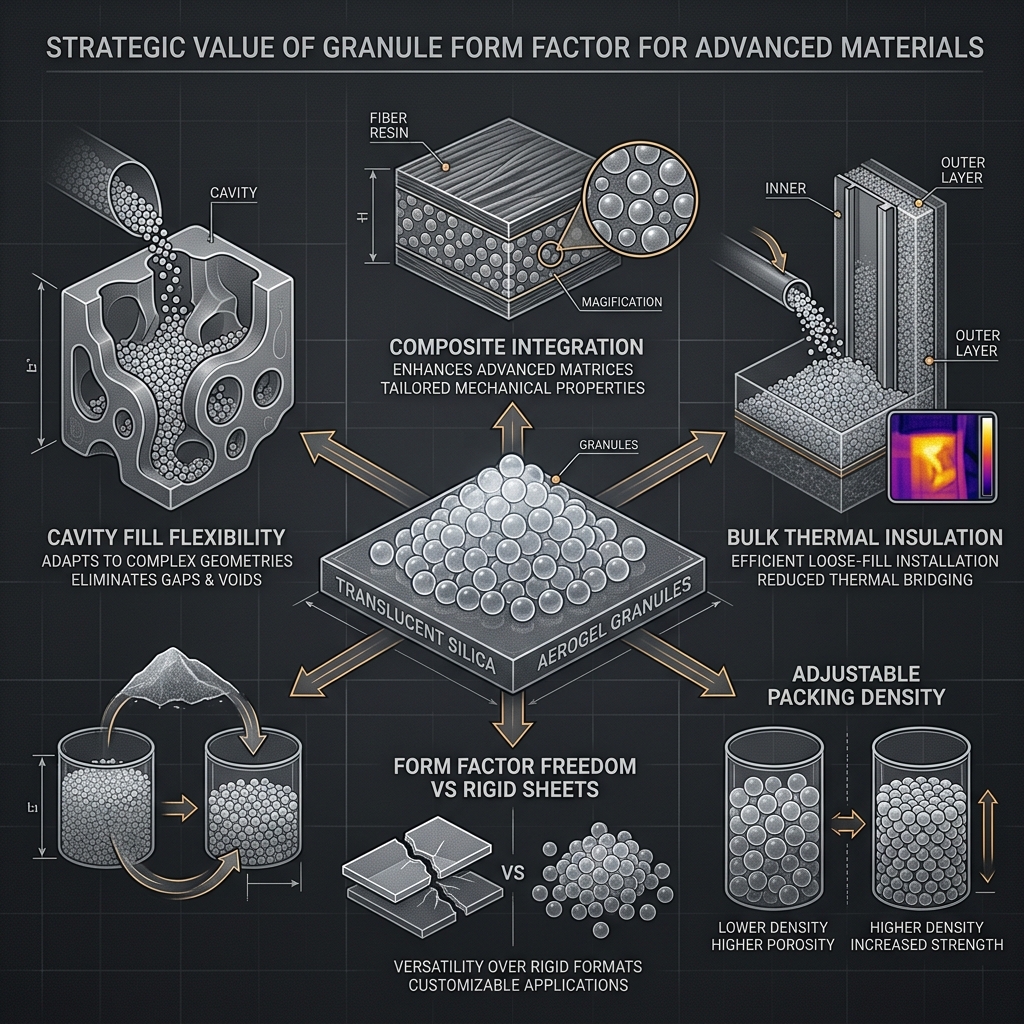
Unlike rigid sheets or pre-formed blankets, granules can fill irregular cavities, integrate into composite matrices, and adapt to geometries that other aerogel formats cannot serve.
The granule form gives engineers and product developers a degree of material integration freedom that rigid aerogel formats simply cannot provide. It transforms aerogel from a fixed-geometry product into a configurable insulation medium.
Pour, blow, or pack granules into cavities, channels, and irregular spaces that rigid materials cannot reach. No custom die-cutting or pre-forming required.
Mix granules into polymer matrices, cementitious systems, or resin composites to create hybrid materials with enhanced thermal performance and structural properties.
Control the bulk density and thermal characteristics by adjusting packing configuration — enabling optimized performance for specific application requirements.
Distribute high-performance insulation across large volumes efficiently. Ideal for loose-fill applications, cavity insulation, and bulk thermal management systems where sheet materials are impractical.
Key performance parameters from Levron Aerogel Granule testing. Every number represents measured performance from laboratory evaluation — providing the technical foundation for material selection decisions.
Among the lowest thermal conductivity values of any commercially available granular material. Nano-scale pore confinement physically constrains gas-phase heat transfer — delivering thermal insulation performance per millimeter that far exceeds conventional fillers.
Full operating range from cryogenic to high-temperature environments. Granules maintain structural and thermal integrity across the entire temperature spectrum without degradation.
The nano-porous structure provides meaningful sound absorption — adding acoustic insulation value alongside thermal performance for multifunctional material design.
Non-combustible silica structure resists direct flame exposure up to 650°C. The granules do not contribute to fire load and maintain structural integrity under extreme thermal stress.
Surface chemistry creates complete water and moisture resistance. Unlike conventional insulation that loses 50%+ efficiency when wet, aerogel granules maintain full performance in any humidity condition.
Over 90% of the granule structure is trapped air — making it one of the lightest solid material formats available. Ultra-low density enables massive thermal protection with minimal mass penalty.
Extraordinary internal surface area supports filtration, adsorption, and chemical interaction applications beyond thermal insulation — enabling multifunctional material strategies.
Transparency characteristics can be tuned depending on granule size, packing density, and application context — enabling specialty architectural and translucent insulation concepts.
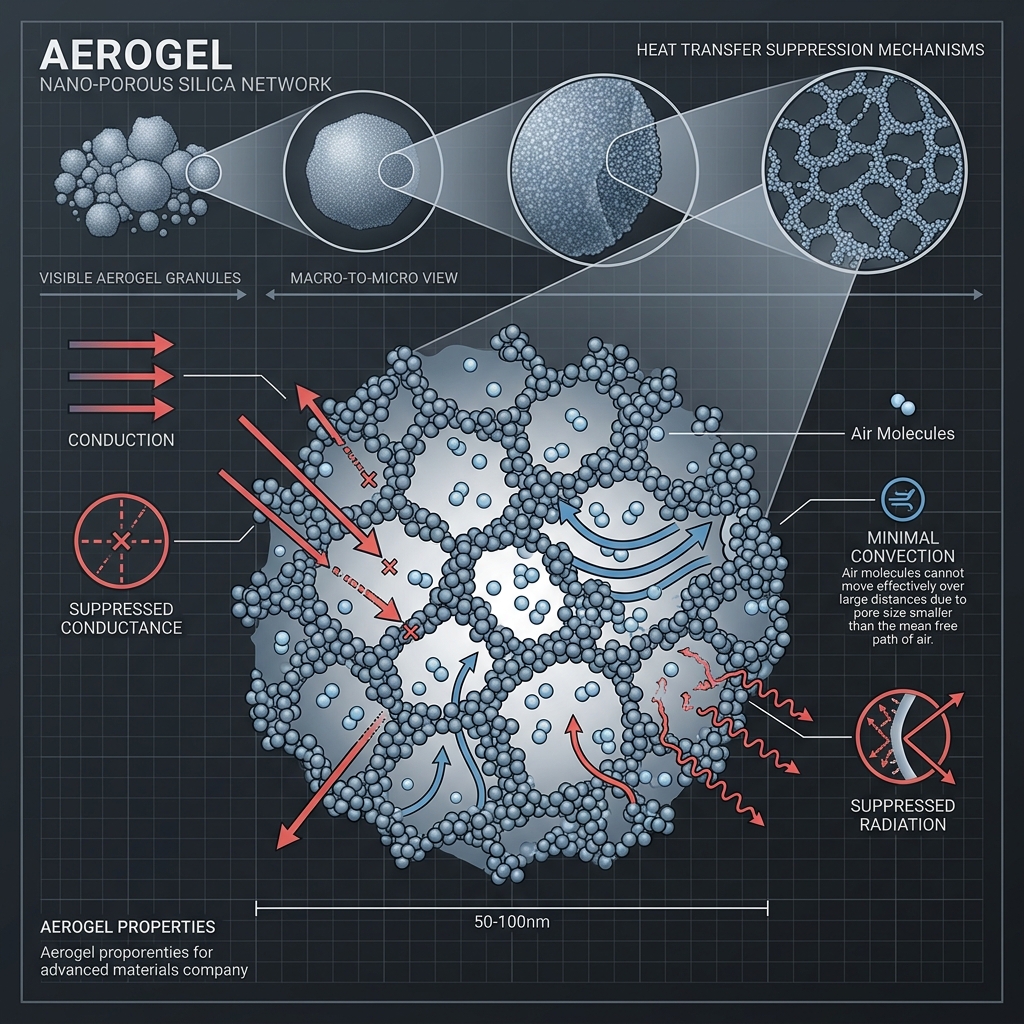
The extraordinary performance of Levron Aerogel Granules is not achieved by adding more material — it's engineered into the fundamental molecular architecture. A three-dimensional silica network that suppresses heat transfer through three simultaneous mechanisms.
A silica network with 50–100 nm pore sizes — smaller than the mean free path of air molecules at standard conditions. This physically constrains gas-phase heat transfer, making each granule a micro-insulator of extraordinary efficiency.
Conduction minimized by tortuous solid pathways through the silica skeleton. Convection eliminated by molecular-scale air confinement within nano-pores. Radiation scattered within the pore network. All three mechanisms addressed simultaneously.
Overwhelmingly composed of trapped air — one of the lightest solid structures known. For weight-sensitive applications, this means effective thermal protection with minimal mass penalty, even in bulk-fill configurations.
Superhydrophobic surface modification ensures moisture rejection at the granule level. Combined with high porosity and massive surface area, this creates a material platform that serves thermal, acoustic, and filtration functions simultaneously.
Levron Aerogel Granules serve diverse application clusters — from thermal insulation systems to specialty filtration concepts. Each pathway leverages different aspects of the same multifunctional material platform.
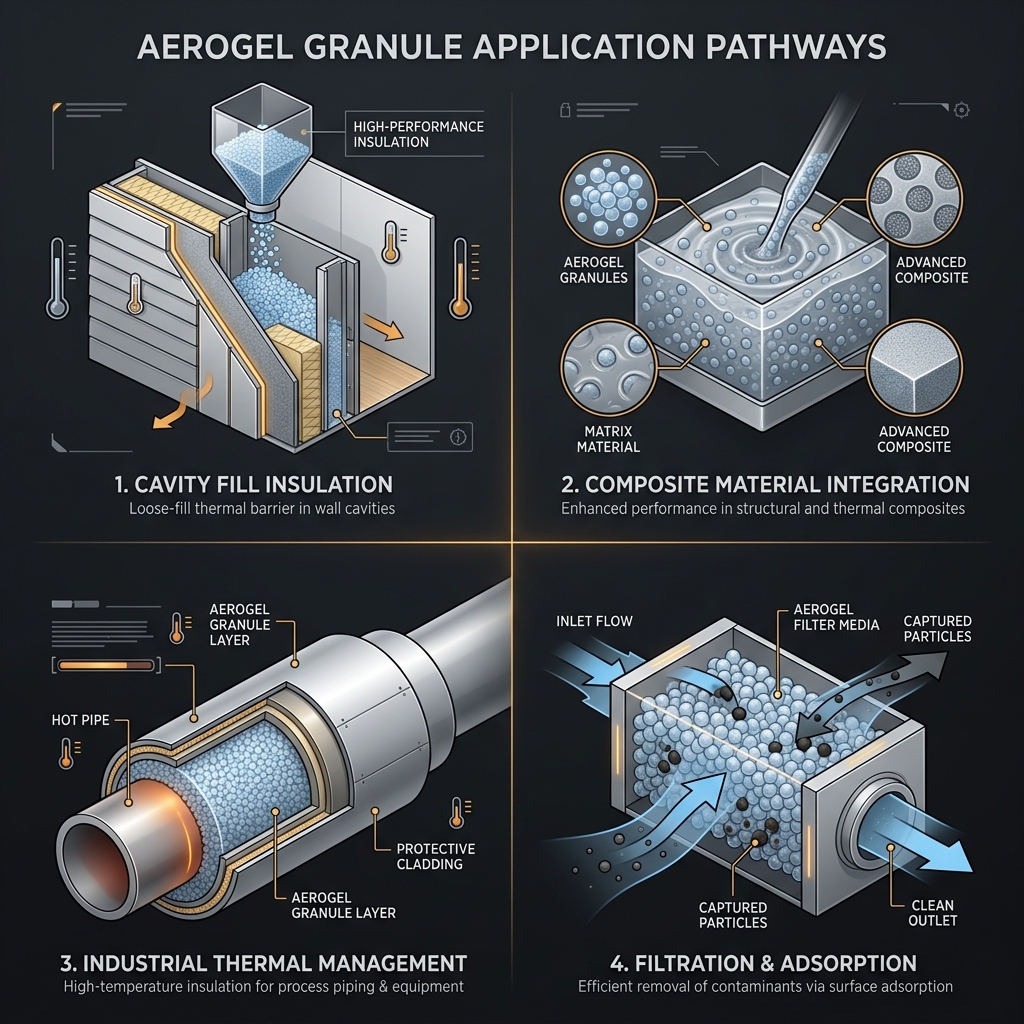
Pour or blow granules into wall cavities, ceiling voids, and floor structures for high-performance thermal insulation without pre-forming or custom cutting.
Fill annular spaces around pipes, vessels, and process equipment with aerogel granules for compact, high-temperature insulation in industrial environments.
Integrate granules into lightweight panel systems, modular insulation cassettes, and pre-fabricated thermal barrier assemblies for weight-sensitive applications.
Granules maintain structural integrity up to 650°C, supporting product designs that operate in sustained high-temperature environments.
Use aerogel granules as fire-resistant fill material in protective assemblies, compartment barriers, and thermal partition systems.
Surround thermally sensitive electronics, sensors, and mechanical components with granule-based insulation that blocks conducted and radiated heat.
Adjustable transparency enables specialty architectural and daylighting applications where thermal insulation and light transmission are both required.
Sound absorption up to 25 dB combined with thermal insulation creates dual-function material solutions for noise-sensitive environments.
Granules serve as feedstock for custom-engineered composite materials, advanced coatings, and next-generation thermal management systems developed through R&D collaboration.
700+ m² per gram of internal surface area supports nano and micro particle capture — relevant for advanced filtration media and environmental remediation concepts.
Oleophilic behavior enables oil-water separation and hydrocarbon adsorption applications — a specialty capability enabled by the unique surface chemistry of the aerogel structure.
A structured performance comparison across key parameters — helping engineers and material selectors understand where aerogel granules deliver meaningful advantages over conventional alternatives.
| Parameter | Perlite / Vermiculite | Glass Microspheres | Calcium Silicate | Levron Aerogel Granules |
|---|---|---|---|---|
| Thermal Conductivity | 0.04–0.07 W/m·K | 0.04–0.06 W/m·K | 0.05–0.08 W/m·K | 0.016 W/m·K |
| Max Temperature | 650–1000°C | 350–600°C | 800–1000°C | 650°C (superhydrophobic) |
| Water Resistance | Absorbs moisture | Variable | Absorbs moisture | Superhydrophobic |
| Weight Efficiency | Moderate density | Light | High density | Ultra-light (>90% air) |
| Sound Absorption | Moderate | Low | Low | Up to 25 dB |
| Surface Area | Low | Low | Low | 700+ m²/g |
| Form-Factor Versatility | Loose-fill only | Limited | Rigid blocks | Fill + Composite + Custom |
| Multifunctionality | Single function | Single function | Single function | Thermal + Acoustic + Filtration |
Values represent Levron Aerogel internal testing data compared to representative ranges for conventional granular and particulate insulation material classes. Actual performance depends on specific configurations and operating conditions.
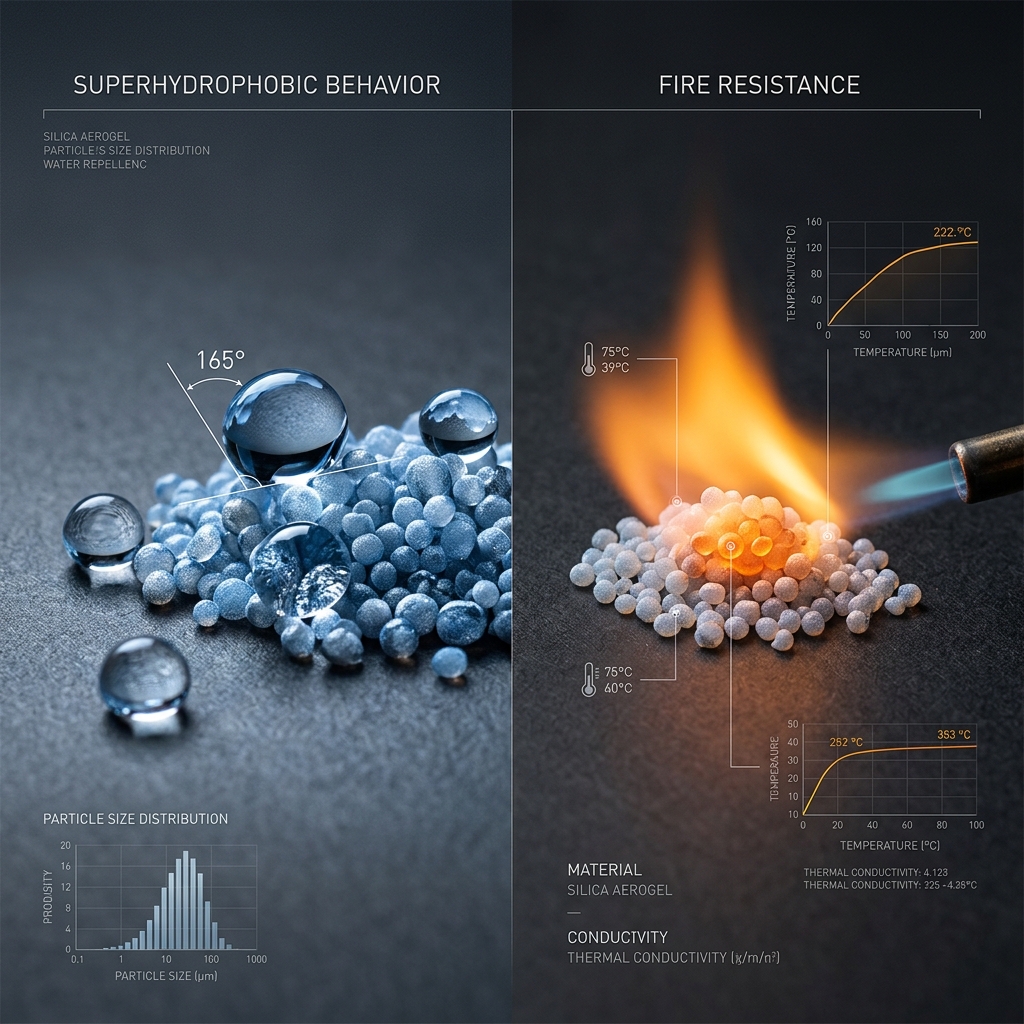
Levron Aerogel Granules exhibit superhydrophobic behavior — complete water and moisture rejection at the particle level. While conventional granular insulation materials absorb moisture over time and lose 50%+ of thermal efficiency, aerogel granules maintain identical performance regardless of humidity, condensation, or direct water exposure.
The silica-based composition provides inherent fire resistance. Granules do not contribute to fire load, cannot sustain flame, and maintain structural integrity under sustained thermal exposure up to 650°C. This makes them suitable for fire-resistant filler concepts, protective barrier assemblies, and thermal partition systems.
The combination of moisture immunity and fire resistance creates material confidence in harsh environments. Systems operating in humid, wet, chemically aggressive, or thermally extreme conditions require insulation that doesn't degrade — aerogel granules deliver both properties inherently, without coatings or secondary treatments.
No performance degradation. No biological growth. No maintenance cycle. Hydrophobic and fire-resistant properties are engineered into the molecular structure — not applied as surface treatments that can wear off or degrade over the system lifecycle.
Levron Aerogel Granules deliver performance across multiple dimensions simultaneously — creating material system value that single-function insulation products cannot match.
The nano-porous architecture is overwhelmingly composed of trapped air — making aerogel granules among the lightest solid insulation materials commercially available. For weight-sensitive product design, this means maximum thermal protection with minimum mass contribution. Every gram of unnecessary weight eliminated through material selection improves system efficiency.
The nano-porous structure absorbs sound energy through viscous dissipation within the pore network. Combined with thermal insulation, this creates a dual-function material that addresses both thermal and acoustic requirements in a single fill — reducing material count and integration complexity.
Extraordinary surface area supports advanced filtration media, adsorption applications, and catalytic support structures. The adjustable transparency characteristic enables translucent insulation concepts for architectural and specialty daylighting applications.
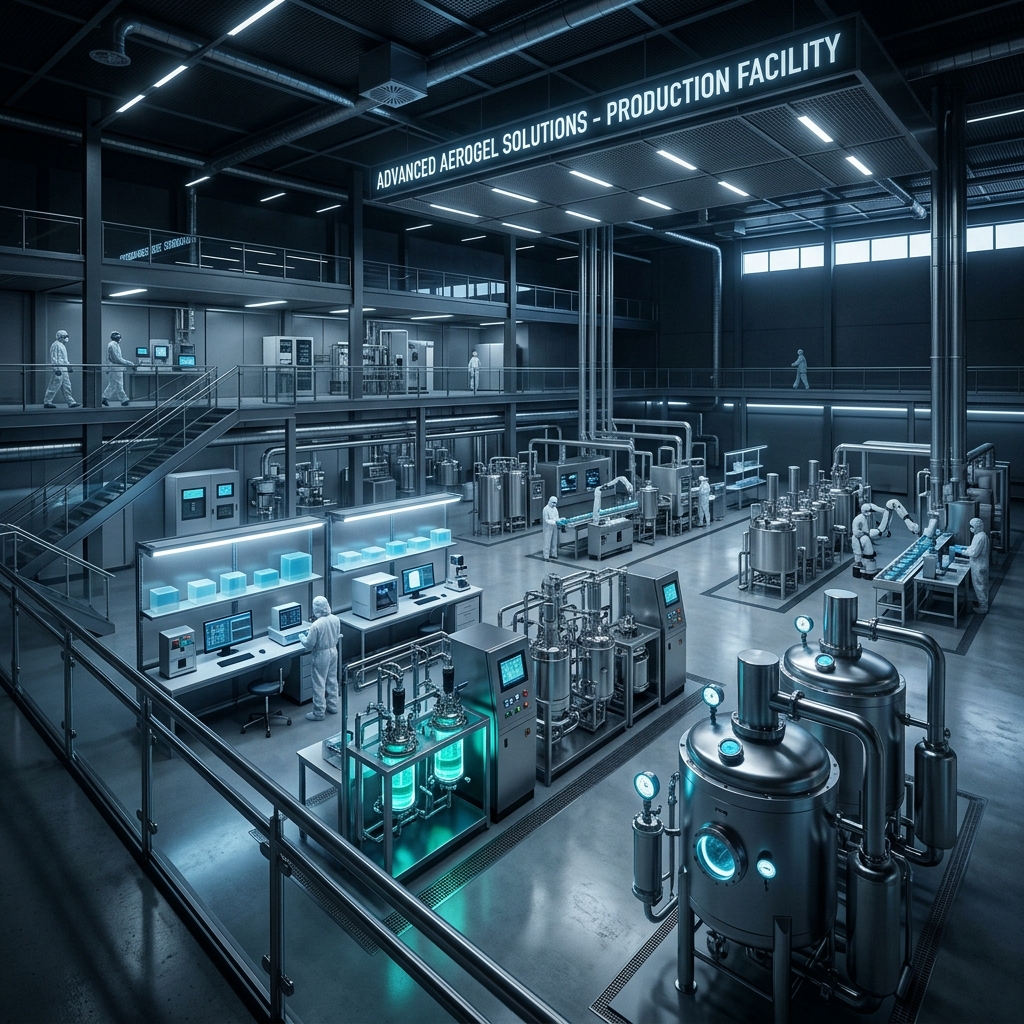
Levron Aerogel is not a product reseller. We are a vertically integrated aerogel manufacturer with deep chemistry expertise, proprietary production processes, and the engineering flexibility to support custom material development.
Thousands of laboratory experiments spanning silica, polymer, metal oxide, carbon, and cellulose aerogel systems. Deep chemistry knowledge enables rapid material customization for specific performance requirements.
Complete vertical integration — from raw material processing through Sol-Gel synthesis to final granule production. Full quality control at every production stage. Not dependent on external supply chain.
Aerogel Felt and Aerogel Granules from the same material chemistry platform — ensuring consistency, cross-product compatibility, and unified engineering support across product formats.
From custom particle size distribution to application-specific surface treatments — our R&D lab supports co-development of tailored aerogel granule products for specific integration requirements.
A structured engagement framework designed to build material confidence efficiently — supporting engineers, product developers, and procurement teams through every evaluation stage.
Receive physical granule samples for hands-on evaluation. Assess particle size, texture, density, and material behavior in your specific application context.
Discuss your application requirements with our materials engineering team. Receive guidance on granule selection, packing configuration, and integration approach.
Access comprehensive technical documentation covering thermal, mechanical, chemical, and environmental performance data for informed material selection.
Small-batch production for prototype testing and application validation — establishing performance confidence before integration commitment.
Volume production with dedicated quality assurance, supply consistency, and ongoing technical support — from our integrated 4,000 m² facility.
Access documentation, request resources, and explore technical knowledge to support your aerogel granule assessment and material selection process.
Full specifications: thermal conductivity, particle size, surface area, sound absorption, and application guidance for granule-based configurations.
Download PDF →Receive physical samples of Levron Aerogel Granules for hands-on evaluation, testing, and application prototyping.
Request Samples →Environmental and safety specifications. Non-toxic, eco-safe, and human-friendly material — compliant with workplace safety requirements.
Download MSDS →What are silica aerogel granules? How are they made? Why do they outperform conventional insulation materials? A technical overview for materials evaluation.
Request Guide →Technical explanation of how nano-porous architecture enables ultra-low thermal conductivity — with comparison data against conventional alternatives.
Request Article →How superhydrophobic surface chemistry protects insulation performance in moisture-exposed environments. Comparison with conventional materials.
Request Guide →When to use aerogel granules vs. aerogel felt. Application selection guidance based on geometry, thermal requirement, and integration method.
Request Guide →Book a one-on-one session with our materials engineering team to discuss specific application requirements and granule integration concepts.
Schedule Call →Levron Aerogel Granules are produced in multiple particle size distributions depending on application requirements. Standard ranges span from fine granules suitable for composite integration to coarser particles optimized for cavity fill and loose-fill applications. Custom particle size distribution can be discussed through our engineering consultation process.
Yes. Aerogel granules can be incorporated into polymer matrices, cementitious systems, plasters, coatings, and resin composites to create hybrid materials with enhanced thermal insulation performance. The specific loading ratio and mixing protocol depends on the matrix material and target thermal properties — our engineering team can provide guidance for your specific integration scenario.
Aerogel felt (0.012–0.016 W/m·K) provides continuous-sheet thermal barrier coverage and is ideal for wrap, lining, and die-cut applications. Granules (0.016 W/m·K) offer form-factor flexibility — filling cavities, integrating into composites, and serving bulk-fill applications that sheet materials cannot address. Both come from the same Levron Aerogel material platform with complementary application strengths.
Yes. Levron Aerogel Granules are non-toxic, eco-safe, and human-friendly. The material does not cause skin irritation, respiratory issues, or environmental contamination. Full MSDS documentation is available for download. Standard industrial handling precautions apply as with any particulate material.
Levron Aerogel Granules maintain thermal, hydrophobic, and structural performance over extended periods depending on application conditions. The silica-based composition does not degrade, support biological growth, or require maintenance. Service life depends on the specific application system design and environmental conditions.
Yes. Our R&D laboratory supports custom granule development including specific particle size distributions, surface treatment modifications, and application-specific formulations. Custom development projects typically begin with a technical discussion to define performance requirements, followed by sample production and iterative testing.
We provide sample quantities for initial material evaluation at no cost for qualified engineering inquiries. Pilot quantities for prototype testing and application validation can be produced through our engineering collaboration process. Contact our team to discuss your specific evaluation needs.
Choose the engagement pathway that matches your evaluation stage. Our team supports engineers, product developers, procurement teams, and strategic partners.
Discuss material capabilities, thermal modeling, and integration concepts with our engineering team.
Talk to an EngineerRequest granule samples for prototyping and application testing in your specific product context.
Request SampleRequest pricing, lead times, and volume supply information for your material requirements.
Request QuoteInitiate a technical discussion around co-development, custom material programs, or partnership exploration.
Start a Discussion